Residential flagpole installation in Atlanta comes down to three local factors a generic install guide will not cover: the area’s 115 mph design wind speed, the expansive red clay of the Georgia Piedmont, and a patchwork of permitting rules that change from one municipality to the next. Get those three right and a 20-foot pole will stand straight through decades of Georgia storms. Get them wrong and you risk a leaning pole, a cracked foundation, or a stop-work order from the county.
This guide walks an Atlanta-area homeowner through everything needed to put a 20-foot or 25-foot flagpole on their property the right way. We manufacture these poles about 30 miles up I-75 in Acworth, so the wind, soil, and code conditions in this guide are the same ones we engineer for every day.
Quick answer: the five things every Atlanta homeowner needs to know
- Wind rating. Metro Atlanta’s design wind speed is 115 mph (ultimate, 3-second gust). Choose a pole whose published wind rating meets or exceeds that basis for your site, with the flag attached if you fly one continuously.
- Soil. Most of metro Atlanta sits on expansive Piedmont red clay that swells when wet and shrinks when dry. Your foundation needs proper depth and drainage to handle it.
- Foundation. A 20-foot pole typically sets about 2 feet into a ground sleeve (PVC or steel), surrounded by a concrete footing sized for wind load and local soil. Do not shallow out the hole to save effort.
- Permits. A 20+ foot pole is a permanent structure on a concrete foundation, so many metro jurisdictions require a building permit (and a separate electrical permit if you add lighting). Rules vary by city and county. Confirm with your building department before you dig.
- Call 811. Georgia law requires you to have underground utilities located before mechanized digging. It is free, and you call at least 48 hours (about two business days) ahead.
What’s in this guide
Metro Atlanta’s design wind speed is 115 mph
Metro Atlanta sits in a 115 mph ultimate design wind speed zone under ASCE 7, the wind-load standard Georgia’s building code references through the International Residential Code. That number is a 3-second gust measured at 33 feet above the ground in open terrain (Exposure Category C). Georgia moved to the 2024 IRC and IBC (which carry the 2022 edition of ASCE 7) with state amendments effective January 1, 2026, and the City of Atlanta Office of Buildings aligned its permitting on the same date. The 115 mph basis holds steady across the recent editions of the standard, so it is the number to size to.
Flagpole wind ratings, on the other hand, are commonly published at nominal (allowable stress design) speeds per the NAAMM FP 1001-07 flagpole standard. The nominal equivalent of metro Atlanta’s 115 mph ultimate speed is roughly 90 mph. In plain terms: a residential pole rated for at least 90 mph nominal meets the metro Atlanta basis. For open, exposed lots or for flying a flag around the clock, step up to a higher rating.
The single biggest variable people overlook is the flag itself. A flag flying in the wind multiplies the load on the pole, so manufacturers publish two ratings: one with the flag down and a lower one with the flag flying. The ratings below assume nylon flags; heavier polyester flags produce higher wind loads and lower the rating further.
What actually changes your pole’s wind rating
| Factor | Pushes the rating up | Pulls the rating down |
|---|---|---|
| Wind exposure | Exposure B (typical suburban lots with trees and houses nearby) | Exposure C or D (open fields, lakefront, hilltops) |
| Flag flying | No flag, or flag down in storms | Flag flying continuously |
| Flag material | Nylon (lighter, lower load) | Polyester (heavier, higher load) |
| Pole height | Shorter pole | Taller pole |
| Shaft geometry | Thicker wall and larger butt diameter | Thin wall, small diameter |
Most metro Atlanta homes fall into Exposure Category B because surrounding trees and structures slow the wind. Lakefront lots on Allatoona or Lanier, properties on open ridgelines, and homes backing up to large fields can be Exposure C, which raises the load meaningfully. When you are not sure, design to the more demanding category.
To pull an exact wind rating for a specific pole height, diameter, and wall thickness at your address, run the numbers through FlagCo’s wind speed lookup tool and then configure the pole in FlagCo’s Cut Sheet Builder, which generates a spec sheet with the wind rating for your exact configuration. FlagCo’s ratings reference ASCE 7-10 and a nylon flag baseline.
Not sure what rating your Atlanta lot needs?
Send us your address and we will pull the wind speed, factor in your exposure, and size the pole, foundation, and flag for your exact site. Then we quote it. We build the poles here in Acworth, so you are talking to the people who make them.
Georgia Piedmont red clay: what it does to a foundation
Metro Atlanta sits squarely in the Piedmont region, where the soil is the famous red clay. That red color comes from a high iron content. The trait that matters for your flagpole is that Piedmont clay is expansive: it absorbs water slowly and holds it, swelling when saturated and shrinking when it dries out. Saturated Piedmont clay can expand by 10 percent or more of its dry volume, and the region averages roughly 52 inches of rain a year, so the soil cycles through wet and dry swings constantly.
For foundations, that shrink-swell cycle drives heave and differential movement, especially in shallow footings. North metro communities such as Roswell, Alpharetta, Johns Creek, Milton, Sandy Springs, and Dunwoody sit on some of the most expansive clays in the area, with montmorillonite (a highly active clay mineral) common in the soil profile. Below the active clay you usually reach saprolite, a firmer weathered-rock layer that makes a much better bearing surface.
Three practical consequences for a residential flagpole foundation:
- Depth. Set the foundation deep enough to anchor below the most active part of the moisture zone, not just deep enough to stand the pole up. Unlike northern climates, the governing factor here is not a deep frost line (metro Atlanta’s frost depth is shallow); it is wind overturning resistance plus the clay’s seasonal movement.
- Drainage. Water pooling at the base is the enemy. A gravel drainage bed under the footing and grading that slopes water away from the pole both reduce the swell-shrink stress that loosens a pole over time.
- Width. A wider footing spreads the overturning load across more soil. In soft, filled, or highly plastic clay, expect to go wider and deeper than a generic chart suggests, and have an engineer size it for taller or heavier poles.
Foundation and set depth for a 20 to 25 foot pole
A flagpole foundation has two parts people often confuse. The set depth is how far the pole or its ground sleeve sits below grade. The footing is the concrete that surrounds the sleeve and resists the wind trying to tip the pole over. Both matter.
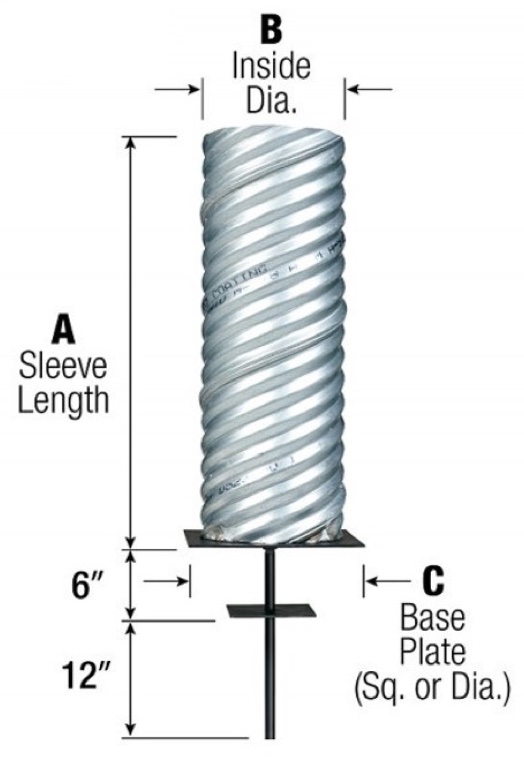
The ground-set sleeve system
The pole drops into a ground sleeve set in concrete: either PVC, or a steel sleeve like the one shown (welded base plate and grounding spike) on heavier and commercial-grade poles. The sleeve sets the depth; the footing around it carries the wind load.
| Pole height (above grade) | Typical ground-set depth (steel sleeve) | Notes for metro Atlanta |
|---|---|---|
| 20 ft | About 2 ft set depth | Most common residential height; pairs with a 4 ft x 6 ft flag |
| 25 ft | About 2.5 ft set depth (one-piece shafts ship at roughly 27 ft 6 in overall, with 2 ft 6 in below grade) | Better for large lots; heights above 25 ft start to read commercial in a neighborhood, and some HOAs cap pole height at 20 or 25 ft |
Set depths come from the pole manufacturer’s specification. The concrete footing around the sleeve is what you size for wind and soil. A widely used installer rule of thumb is a footing depth equal to about 10 percent of pole height plus an allowance for the gravel base, but in expansive Atlanta clay it is common to go deeper and wider, with footing diameters in the range of roughly 16 to 24 inches or more for residential poles. The NAAMM Metal Flagpole Manual gives baseline foundation dimensions for firm, dry soil using 3,000 psi concrete, but it explicitly notes that site soil conditions vary and that a structural engineer should verify the final design. For a 25-foot pole on poor or filled soil, that engineering check is money well spent.
A few foundation details that separate a pole that lasts from one that leans:
- Pour at least 3,000 psi concrete and let it cure fully before raising the pole.
- Set the ground sleeve dead level. A sleeve that is even slightly off plumb shows badly at 20 feet.
- Place a gravel bed (roughly 6 inches) under the sleeve so water drains rather than sitting against the base.
- Most residential poles use a 6063-T6 aluminum shaft set in a ground sleeve, PVC or steel depending on the pole and project. FlagCo’s steel ground sleeves include a factory-welded grounding provision.
Permits and zoning: it depends on your municipality
Here is the part that trips up most Atlanta homeowners. There is no single metro-wide flagpole rule. The city or county your address falls under sets its own requirements, and they cover several separate questions:
- Zoning (setbacks and height). How far from your property lines the pole must sit, and whether your zoning district treats a flagpole the same as a building for height purposes. Many residential codes exempt flagpoles from the principal-building height limit but still enforce setbacks. Some jurisdictions cap residential flagpole height outright. This is the rule most likely to surprise you, so verify it specifically.
- Building permit. Because a 20+ foot pole is a permanent structure set in a concrete foundation, many metro jurisdictions require a building permit. Thresholds and exemptions vary.
- Electrical permit. If you add a ground light or a Beacon flagpole light so you can fly the flag at night, that almost always requires a separate electrical permit and licensed work.
- HOA approval. Covered separately below.
Where to verify, by jurisdiction
| Jurisdiction | Who to contact | What to confirm |
|---|---|---|
| City of Atlanta | Office of Buildings; Office of Zoning and Development | Height treatment and setbacks. Note: Atlanta’s zoning is being rewritten through ATL Zoning 2.0, so rules may shift. Building permit for the foundation. |
| Cobb County (unincorporated) | Community Development | Setbacks; plan review thresholds for accessory structures. Building permit. |
| Marietta, Acworth, Kennesaw, Smyrna, Mableton | City building and zoning department | City rules differ from the county; Mableton now issues its own permits. |
| Fulton County cities (Alpharetta, Roswell, Sandy Springs, Johns Creek, Milton) | City community development department | Height treatment and setbacks; expansive-clay foundation considerations are highest here. |
| DeKalb County, Decatur, Brookhaven, Dunwoody | DeKalb County, or your city’s building department | Setbacks; permit requirement for the foundation. |
| Gwinnett County and its cities | Planning and Development | Setbacks and permit thresholds. |
| Cherokee, Forsyth, Paulding, Henry, Douglas, Clayton | County building department | Setbacks and permit requirement. |
A ten-minute phone call to the right department before you order the pole will save you from buying a 25-foot pole for a lot that caps you at 20 feet, or from setting concrete inside a required setback. When you call, ask three questions: Is a flagpole exempt from the height limit in my zoning district? What are my setbacks? Do I need a building permit for a foundation-set flagpole?
HOA rules and your right to fly the flag
If you live in an HOA, read your covenants before anything else. Under the federal Freedom to Display the American Flag Act of 2005, an HOA cannot prohibit you from displaying the U.S. flag, and Georgia has its own flag-display protections as well. But the law allows HOAs to impose reasonable restrictions on the time, place, and manner of display, and that includes regulating or requiring architectural approval for an in-ground flagpole and its height. Submit your flagpole plan to the architectural review committee and get approval in writing before you dig. This is general information rather than legal advice; if your HOA pushes back, talk to an attorney who handles Georgia property law.
Step-by-step: installing your flagpole
- Pick the pole and flag. For most Atlanta yards, a 20-foot pole with a 4 ft x 6 ft flag is the right scale. Keep the flag size proportional, roughly one foot of flag fly for every foot of pole height.
- Confirm zoning, setbacks, and permits. Call your city or county per the table above. Pull a building permit if required, and an electrical permit if you are adding lighting.
- Check your HOA. Get written architectural approval if you are in a covenanted community.
- Call Georgia 811. Submit a locate request at georgia811.com or call 811 at least 48 hours (about two business days) before you dig, and no more than 10 working days ahead. Wait for the lines to be marked. Remember that 811 marks public utilities only; private lines such as irrigation, low-voltage lighting, invisible pet fences, and lines to detached structures are your responsibility and may need a private locator.
- Excavate. Dig the hole to the depth and width your pole’s foundation detail specifies, adjusted deeper and wider for expansive clay. Add a gravel drainage bed at the bottom.
- Set the sleeve and pour the footing. Place the steel ground sleeve dead level, brace it, and pour at least 3,000 psi concrete. Slope the top of the pour so water sheds away from the pole.
- Let it cure. Allow the concrete to cure fully (follow the mix specification) before putting any load on it.
- Raise the pole and fly the flag. Insert the shaft, install the truck, halyard, and finial, attach the flag, and run it up.
For taller poles, heavy soil, or any uncertainty about the footing, hire a professional installer. The cost of a leaning or failed pole far exceeds the cost of doing the foundation right the first time.
Choosing the right height and flag for an Atlanta yard
Twenty feet is the residential standard for good reason. It is visible from the street without dominating the yard or crowding neighbors, it fits proportionally with one and two-story homes, and it keeps you under the height caps most HOAs and zoning districts use. A 25-foot pole suits larger lots and properties set back from the road. Above 25 feet, a pole starts to look commercial in a residential neighborhood and is more likely to trigger zoning scrutiny and an engineering requirement.

A 20-footer, just up the road
A real FlagCo customer’s pole on a larger metro Atlanta lot, near our Acworth shop. It shows how a 20-foot pole reads on a bigger property, and how many Georgia homeowners fly a second flag below the colors.
- Pole 20 ft, ground-set
- Location Cartersville, GA
- Flying 250th-anniversary U.S. flag and a college flag
If you are weighing options, the FlagCo guide to choosing the right flagpole height walks through the trade-offs by setting and lot size, and you can browse commercial-grade 20 and 25 ft flagpoles built for exactly these conditions. To produce a full specification with shop drawings and wind ratings (useful if your jurisdiction asks for documentation with the permit), FlagCo’s interactive specification builder generates one for your project.
Frequently asked questions
Do I need a permit to install a flagpole in metro Atlanta?
What wind speed should my flagpole be rated for in Atlanta?
How deep does a flagpole foundation need to be in Georgia clay?
Why does the red clay matter for my flagpole?
How tall can a residential flagpole be in the Atlanta area?
Can my HOA stop me from putting up an American flagpole?
Do I really have to call 811 before digging?
What size flag should I fly on a 20-foot pole?
Can I install a flagpole myself, or should I hire a pro?
Should I get a one-piece or sectional pole?
Sources and authorities
- Georgia Department of Community Affairs, Current State Minimum Codes for Construction: dca.georgia.gov
- ASCE 7, Minimum Design Loads and Associated Criteria for Buildings and Other Structures (American Society of Civil Engineers): asce.org
- NAAMM FP 1001-07, Guide Specifications for Design of Metal Flagpoles (National Association of Architectural Metal Manufacturers): naamm.org
- Georgia 811, Call Before You Dig: georgia811.com
- Freedom to Display the American Flag Act of 2005 (federal Public Law 109-243)
Get a flagpole sized for your address
FlagCo is a veteran-owned manufacturer in Acworth, building commercial-grade 20 and 25 ft flagpoles, ground sleeves, and Beacon flagpole lighting. Tell us your address and how you plan to fly the flag, and we will recommend the pole, foundation, and flag, then quote it. No middleman, no guesswork.